Hot Stamping Foil Storage Guide
A film roll is a stored pattern, and storage decides whether it performs as delivered. This guide covers the warehouse habits — ventilation, shade, pressure and wrapping — that protect adhesion and finish.
Hot Stamping Foil Storage Guide: step one
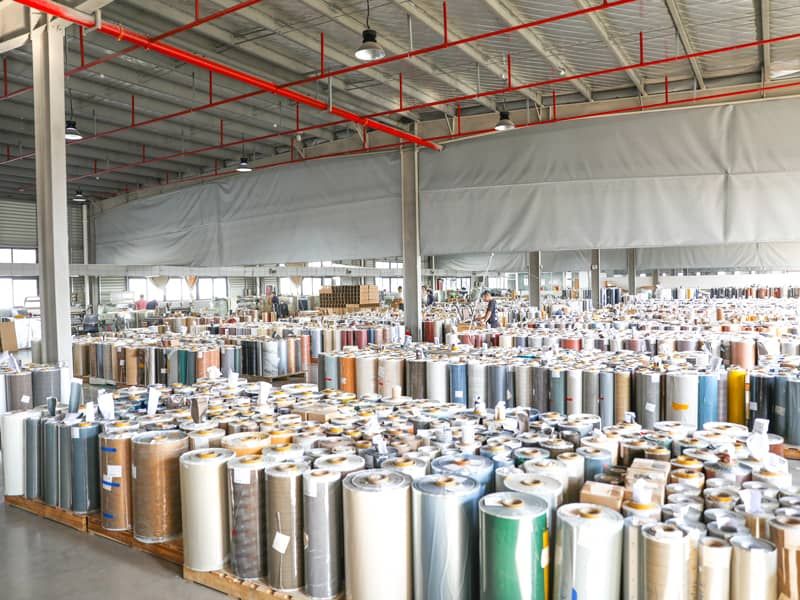
Film is a stored pattern, and storage decides whether it arrives at the machine in the condition it left production. Keep rolls in a ventilated, shaded, cool place, protected from pressure, dampness, heat and direct sunshine. Keep each roll in its wrapping until it is needed, and store rolls so their edges are never the load-bearing surface.
Heat transfer and hot stamping share one principle: heat and pressure persuade a prepared film to give up its decorative layer to the substrate beneath it. The film carries the pattern; the substrate keeps it. Everything in this catalogue is a variation on that exchange, tuned by substrate, pattern and finish.
Hot Stamping Foil Storage Guide: step two
Pressure marks, moisture and heat each leave their signature on a transfer: blocked or pre-released areas, patchy adhesion, gloss variation. Most storage damage is silent until the roll is on the machine, which is why warehouse discipline is a quality step and not a housekeeping detail.
A good inquiry is short but specific: the film type you are considering, the substrate you run, the width and roll length on your machine, and the quantity per design. With those four inputs a quote can confirm the minimum run, the price and the delivery schedule for exactly the film you need.
Hot Stamping Foil Storage Guide: step three
Rotate stock by delivery order, keep different film families separately identified, and record the storage period printed for each film with its job paperwork. When a roll has waited through a hot season, run a short trial length before committing it to a production quantity.
Samples are the fastest route through this catalogue. Stock samples and catalogues let you judge colour, gloss and pattern scale on your own substrate and under your own light before any production quantity is discussed, and custom patterns begin from your drawings or physical samples.
Hot Stamping Foil Storage Guide: step four
At the machine, let a cold-stored roll acclimatise in the production room before unwrapping it, so condensation never forms on the film surface. Small habits at this end of the process protect the finish at the other end.
Custom development follows the same path as the standard range: a design brief or a sample, a pattern developed or matched, a proof on film, a trial on your substrate, and then production. Yearly colour card collections keep the standard range moving, so a pattern family you like can usually be refreshed rather than reinvented.
Hot Stamping Foil Storage Guide: ordering and samples
Custom development follows the same path as the standard range: a design brief or a sample, a pattern developed or matched, a proof on film, a trial on your substrate, and then production. Yearly colour card collections keep the standard range moving, so a pattern family you like can usually be refreshed rather than reinvented.
A good inquiry is short but specific: the film type you are considering, the substrate you run, the width and roll length on your machine, and the quantity per design. With those four inputs a quote can confirm the minimum run, the price and the delivery schedule for exactly the film you need.
Custom development follows the same path as the standard range: a design brief or a sample, a pattern developed or matched, a proof on film, a trial on your substrate, and then production. Yearly colour card collections keep the standard range moving, so a pattern family you like can usually be refreshed rather than reinvented.
What to send with your inquiry
Questions from this guide? Send your substrate, your machine type and the finish you are aiming for.